Programme
JUSTICE & CHANGE
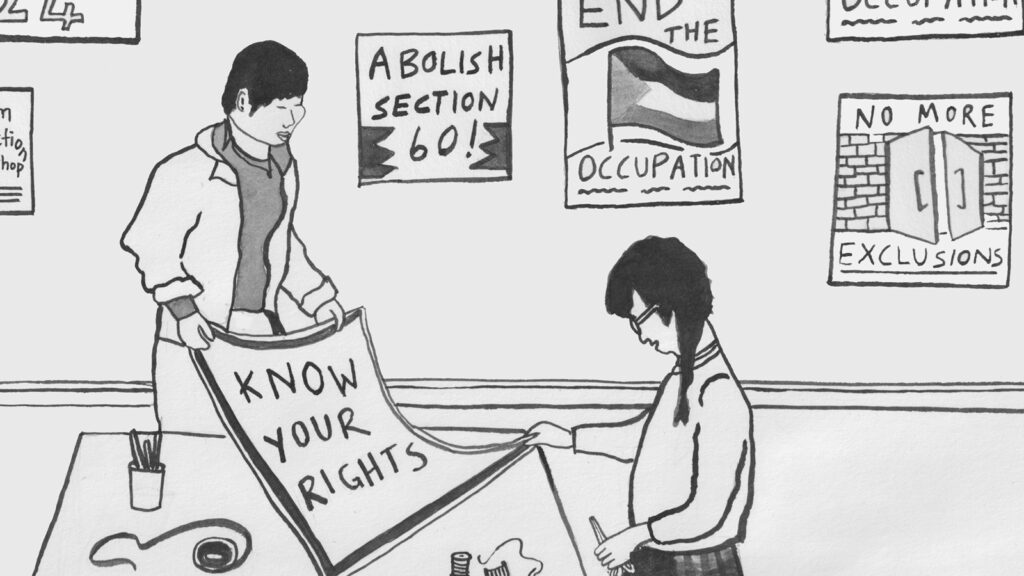
Since opening in Kilburn in 2021, Metroland Cultures has been researching the histories of community resistance, mutual aid, and collective organising that shape our neighbourhood. Building on this work, Justice & Change is a programme that explores how the law shapes our lives, and how communities create forms of justice beyond the limits of the legal system.
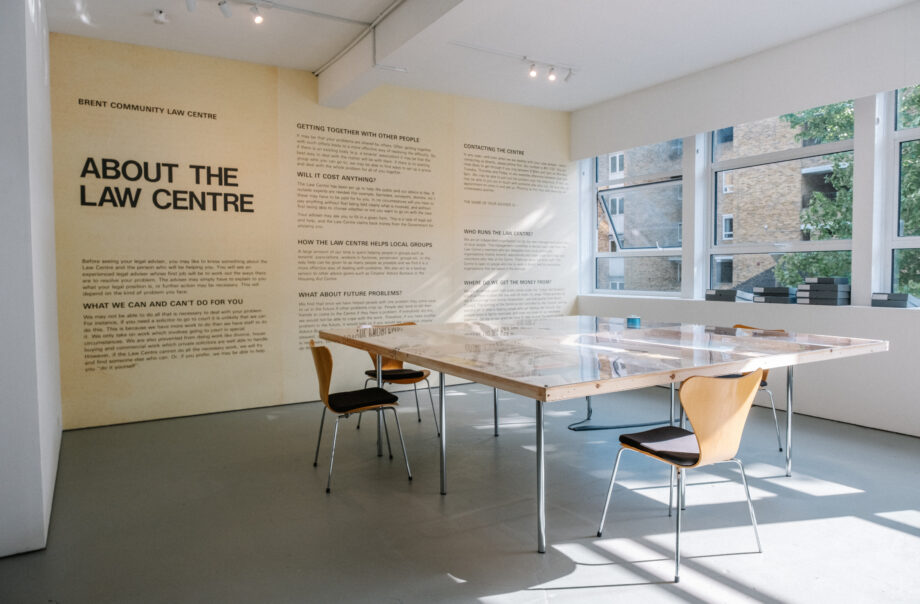
The programme begins with the history of the Brent Community Law Centre (BCLC), one of the first community law centres in the UK, founded in 1971 as part of a wider law centre movement that emerged from a lack of legal welfare support available to working-class communities. Underpinning this work was a central question: what is the role of a lawyer in working-class struggle? In response, BCLC developed a unique approach to law that focused on collective action, whilst also redistributing legal knowledge to community organisations across the borough. From this activity also grew the Young People’s Law Centre (YPLC), which supported young people facing legal struggles in four areas: care, employment, education and the criminal legal system.
Building on this history, Justice & Change brings together community partners – No More Exclusions and Redthread – alongside artists, researchers and young people to learn from this history and respond to it creatively. The project will build and activate the BCLC and YPLC archives, record intergenerational oral histories with people connected to the law centre, and commission new work from artists Francesca Telling and Rehana Zaman. Together, these activities will form a public programme of workshops, archival displays and exhibitions creating spaces for reflection, sharing and collective learning.
Throughout history, racialised and working-class communities have consistently self-organised to keep each other safe from the failures and harms of the legal system. Metroland Cultures’ ongoing research follows these histories in the present, in our neighbourhood, with communities navigating similar conditions, asking what these histories can teach us now.
Since 2012, social welfare legal services have been cut by 99%, leaving many people to navigate complex and often impenetrable legal systems alone and the consequences are everywhere. Young people are imprisoned without trial for taking direct action against weapons manufacturers, while others remain held under the long-abolished Imprisonment for Public Protection sentences. UK prisons expand as education within them is cut, and stop and search powers continue to disproportionately target and criminalise racialised communities. In 2023/24 there was a 21% increase in school suspensions that reached more than 950,000 and permanent exclusions rose by 16% over the same period. Trans people have seen their legal recognition and access to services threatened and hostile migration policies continue to separate families through detention and deportation. The same state that fails people here shows no greater accountability globally: despite the International Court of Justice finding a plausible case of genocide in Gaza, the UK continues to export arms to Israel. As the Home Secretary proposes restricting the role of juries – limiting public participation in the legal system – 23 of the 24 members of Palestine Action’s Filton 24 were granted bail by a jury, an example of the necessity for collective participation within our current legal systems.
In this context, through a process of collective research, the programme will ask questions about the relationship between law and safety: who the law protects, who it fails, and what justice looks like when communities care for one another. It also asks: how can we practise justice as community care? How can listening to past community responses to harm offer us lessons in healing, repair, and prevention for now and in the future? How can exploring these histories creatively support people to respond to the issues that are most impacting them today?
[Programme statement written by Metroland Cultures]
If you have a connection to the BCLC or YPLC, If you worked there, were supported there, or have memories, stories or materials linked to these spaces, we would love to hear from you. Please email meera@metrolandcultures.com
Illustration by Sofia Niazi
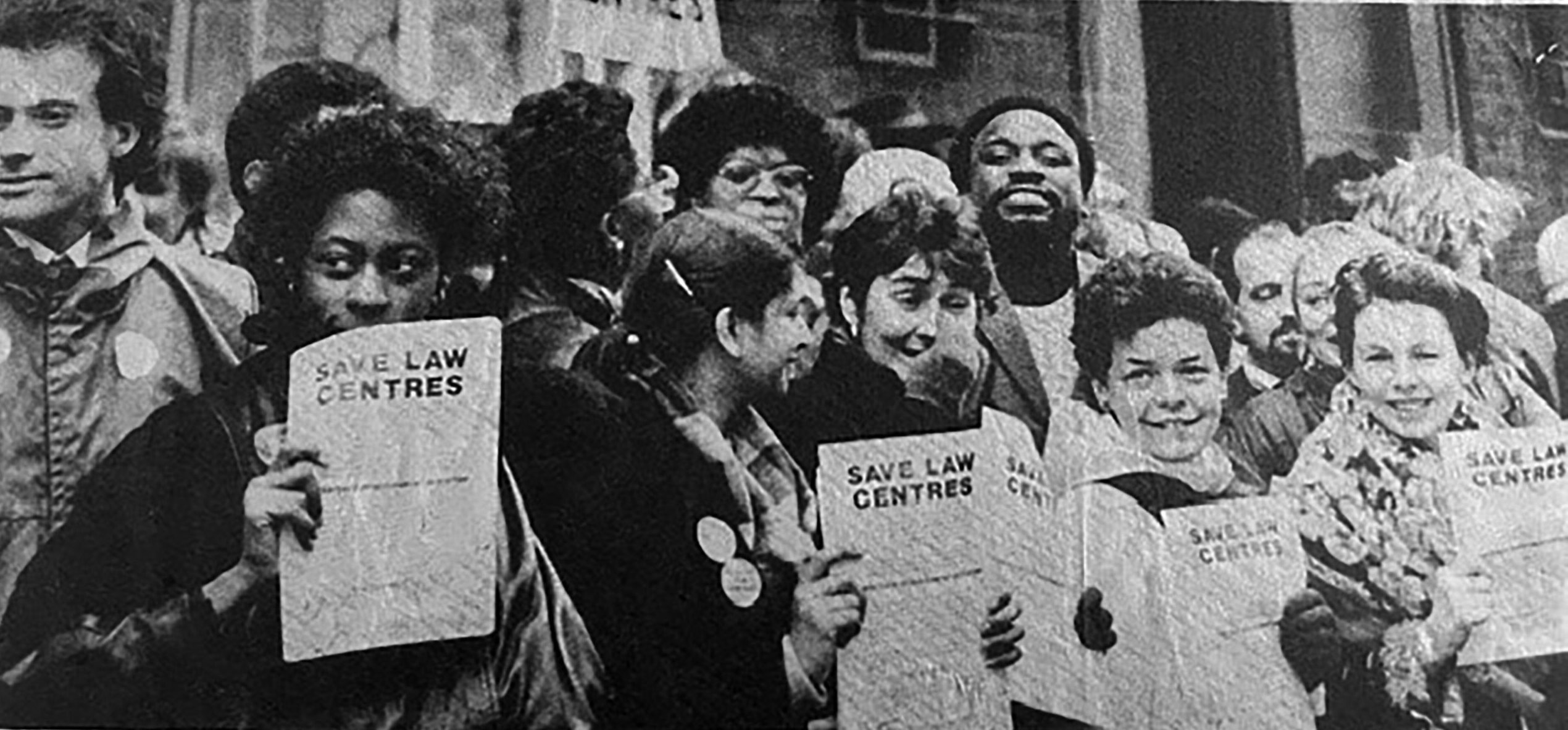
With thanks to BCLC founders and staff who have supported us in the research and development of the programme so far; Jamie Ritchie, Clive Grace, Sian Williams, Irene Grant Bannon, Maureen Vincent and Jeremy Smith, alongside The Willesden Trades Hall and Brent Museum and Archives (Emir Ghariani, Sarah Harrison) and Linda Mulcahy (Radical Lawyering).
Justice & Change collaborators
Francesca Telling
Francesca Telling is an artist and youth worker from London. Working across photography, print, language and time-based media, she is interested in how our knowledges of time and place are produced – between the spaces that care for people and the spaces that care for stories. Her practice centres on the lived and educational experiences of children and young people, developing through collaborations that use listening, documenting, mapping and interviewing as tools for reimagining the forms of hierarchy and separation found within systems young people navigate.
Francesca’s recent projects have emerged as gatherings, interventions and curriculums including facilitating the pilot Young Archivists programme at Croydon Archives, co-research with the collective A Particular Reality, and artworks now living in schools, youth clubs, libraries, archives, universities and shopping centres. Her first solo exhibition ‘Emergency’ was at Metroland Cultures in 2025.
Latifa Akay
Latifa Akay is a facilitator, writer, researcher & producer with over a decade of experience working and organising with communities around social justice issues and on arts-based community projects. Latifa is interested in transformative approaches to safety and justice and produced and co-wrote ‘The Radical Safeguarding Workbook’ in their former role as Director of Education at the charity Maslaha. Latifa works with groups and institutions including schools, grassroots groups and arts spaces on resisting carceral safeguarding and building cultures of care. Latifa was formerly a trustee of the Inclusive Mosque Initiative and co-directed the 2021 MFest at the British Library. Latifa holds an LLM in Human Rights Law and before moving to London in 2012, they worked for two years as a journalist in Istanbul.
No More Exclusions
No More Exclusions (NME) is a Black-led anti-racist organisation working to build an abolitionist grassroots movement in education. Our coalition includes young people, parents, parent advocates, teachers, teaching assistants, trade unionists, social workers, lawyers, youth workers, faith leaders, local councillors, journalists, academics, education researchers, SEND specialists, psychologists and mental health practitioners. We believe that school exclusions form part of a continuum of state violence enacted against communities racialised as Black, brown, Muslim and Gypsy, Roma, Traveller, against disabled people and against working-class communities. We support all those struggling to abolish exclusions and transform education into a nurturing and enriching experience for all children and young people. We work to democratise knowledge, build community power and effect change from the bottom up. We work in coalition and solidarity with many sister collectives and individuals who share our values and vision for liberation and social justice in education and beyond.
On the Record
On the Record is recognised nationally and internationally for co-producing oral history arts & community archives with groups who are otherwise under-represented in culture. We are a not-for-profit organisation guided by co-operative principles, co-founded by Rosa Schling & Laura Khan Mitchison. Our current workers are Laura Khan Mitchison & Tania Aubeelack.
Redthread
Redthread work with children and young people affected by exploitation, violence, mental and physical health issues, grooming and modern slavery. We work alongside NHS staff and other professionals in hospital emergency departments. Our experienced, specialist youth workers engage with and support young victims of violence, aiming to break cycles of violence. We often meet children and young people at a moment of crisis and change and work with them to find a positive way forward. We provide holistic support. We consider every aspect of a young person’s life and build support around them. We work in hospitals and health settings in London and Birmingham. Our youth workers are based in emergency departments, working in partnership with major trauma centres.
Rehana Zaman
Rehana Zaman is an artist living and working in London. Her work speaks to notions of kinship and sociality, seeking out possibilities of intimacy and transgression within hostile contexts. Conversation and cooperative methods sit at the heart of her films which extend into texts, performances and group work. She stands in support of struggles for liberation, from genocide, apartheid, displacement and colonialism; for a free Palestine, free Congo and free Sudan. Her new multiscreen installation,‘Plantation’, will tour between 2026 – 2027 at Site Gallery, Glasgow International, Whitechapel, Project Arts Centre Dublin and Chapter Arts Centre, Cardiff. Recent presentations include Serpentine Civic, BFI London Film Festival, Tromsø Kunstforening, BEK – Bergen Centre for Electronic Arts, British Art Show 9 (Touring), ICA Miami, Trinity Square Video, Toronto, Borås International Sculpture Biennial and Artist Film International Whitechapel (Intnl Touring). In 2023 she was the recipient of the Film London Jarman Award. She is a member of not/nowhere artist workers cooperative and her films are distributed by LUX.
For no reason of my own