14 April 2026
For no reason of my own
For no reason of my own
Exhibition dates: 1 –24 May 2026.
Opening hours: Wed–Sun 12–5pm
Launch evening: 1 May, 6–8pm, free all welcome
For no reason of my own is an archive display that introduces Justice & Change, an ongoing research programme exploring how the law shapes our lives and how communities create justice beyond the limits of the legal system. Bringing together materials from the Brent Community Law Centre (BCLC) and the Young People’s Law Centre (YPLC) alongside films from Cinenova and London Community Video Archive and photographic materials from the North Paddington Community Darkroom, the display situates the law centre movement within a wider landscape of grassroots organising — documenting how working-class communities built infrastructures of mutual support, political education and resistance in response to structural inequality.
The BCLC was one of the first community law centres in the UK, founded in 1971 as part of a wider movement that emerged from a lack of accessible legal welfare for working-class communities. Underpinning this work was a central question: what is the role of a lawyer in working-class struggle? In response, BCLC developed an approach to law grounded in collective action, while redistributing legal knowledge to community organisations across the borough. From this work grew the YPLC, a unique initiative within the movement that supported young people facing legal struggles in care, employment, education and the criminal legal system.
For no reason of my own takes its title from a text by the YPLC, If we can’t get our points across… we ought to have a spokesperson for ourselves (1981), which outlines the need for a specialised legal service for young people. Through correspondence, reports, newspaper clippings, photographs, moving image and paperwork, this presentation traces the conditions that made services like BCLC and YPLC necessary. These archival fragments speak to both legal histories and broader struggles around housing, racism, migration, labour and policing that shaped — and continue to shape — everyday life in Brent and beyond. By placing these materials in dialogue, we ask: what can we learn from collective and community action as a form of justice that extends beyond the limits of legal systems?
Invitation to take care
There are materials in this archive display that document experiences of injustice against Black and other racialised communities. It may awaken your own needs for care in the context of journeys you have experienced, navigated, or witnessed. We encourage you to honour these needs as we share this work together. This could look like: taking a deep breath; pausing to drink water; stepping outside to walk around the Kilburn Square and market.
With thanks to BCLC founders and staff who have supported us in the research and development of the programme so far; Jamie Ritchie, Clive Grace, Sian Williams, Irene Grant Bannon, Maureen Vincent and Jeremy Smith, alongside The Willesden Trades Hall, Brent Museum and Archives (Emir Ghariani, Sarah Harrison), Bishopsgate Archive (Niamh Glanville-Frayne), Cinenova, London Community Video Archive, The Showroom (Scott Lawrimore), Richard Bevan and and Linda Mulcahy (Radical Lawyering).
Curated by Lizzie Graham and Meera Shakti Osborne
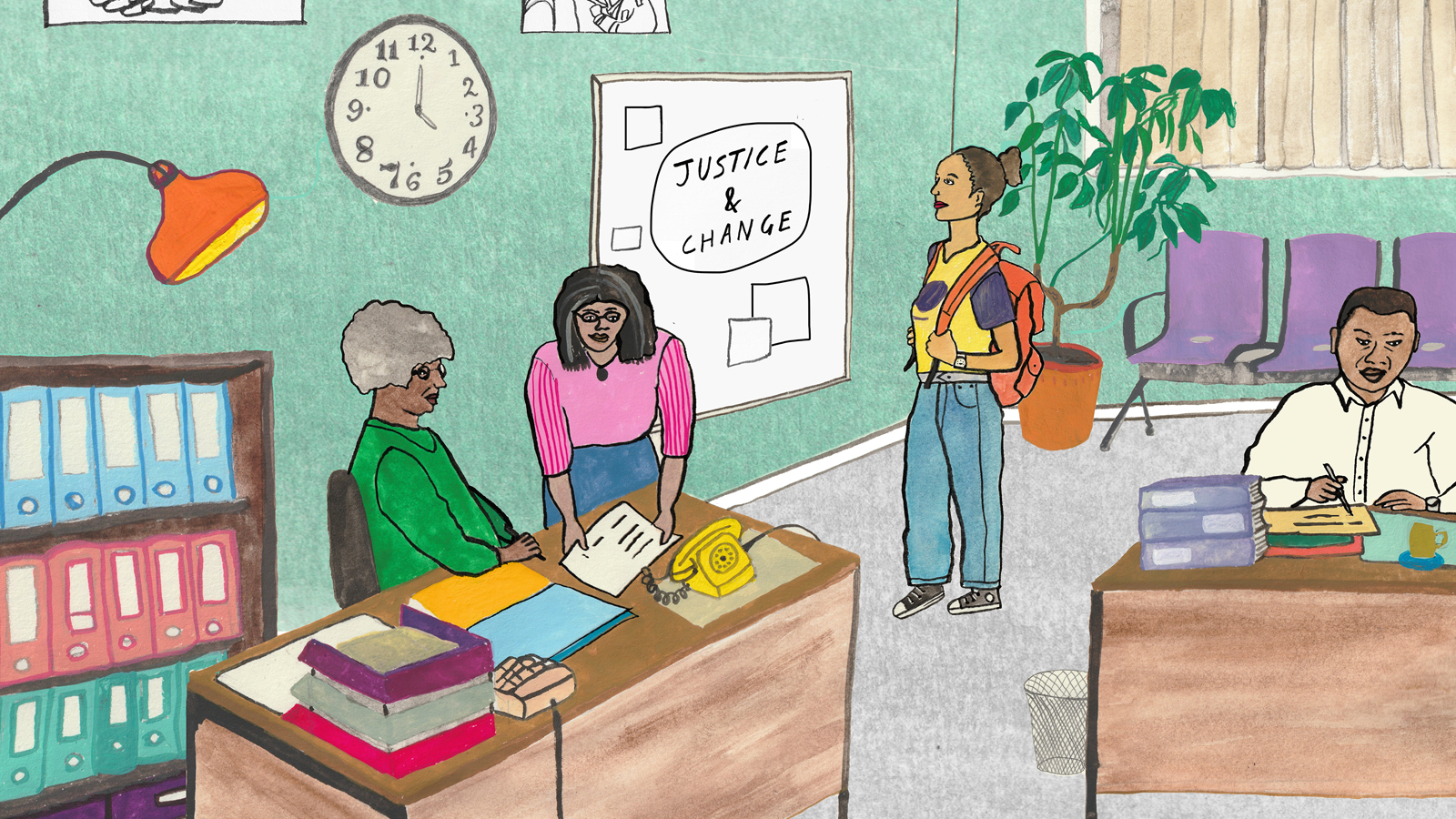
Illustration by Sofia Niazi
For no reason of my own is made possible with The National Lottery Heritage Fund.
Justice & Change
Justice & Change is an ongoing research programme exploring how the law shapes our lives, and how communities create justice beyond the limits of our current legal systems.
The programme begins with Brent Community Law Centre (BCLC), one of the first community law centres in the UK, founded in 1971 as part of a wider law centre movement that emerged from a lack of legal welfare support available to working-class communities. Underpinning this work was a central question: what is the role of a lawyer in working-class struggle? In response, BCLC developed a unique approach to law that focused on collective action, whilst also redistributing legal knowledge to community organisations across the borough. From this activity also grew the Young People’s Law Centre (YPLC), which supported young people facing legal struggles in four areas: care, employment, education and the criminal legal system.
Building on this history, Justice & Change brings together community partners – No More Exclusions and Redthread – alongside artists, researchers and young people to learn from this history and respond to it creatively. The project will build and activate the BCLC and YPLC archives, record intergenerational oral histories with people connected to the law centre, and commission new work from artists Francesca Telling and Rehana Zaman to be launched in 2027. Together, these activities will form an ongoing public programme of workshops, archival presentations and exhibitions creating spaces for reflection, sharing and collective learning.
Through a process of collective research, the programme will ask questions about the relationship between law and safety: who the law protects, who it fails, and what justice looks like when communities care for one another. It also asks: how can we practise justice as community care? How can listening to past community responses to harm offer us lessons in healing, repair, and prevention for now and in the future? How can exploring these histories creatively support people to respond to the issues that are most impacting them today?